
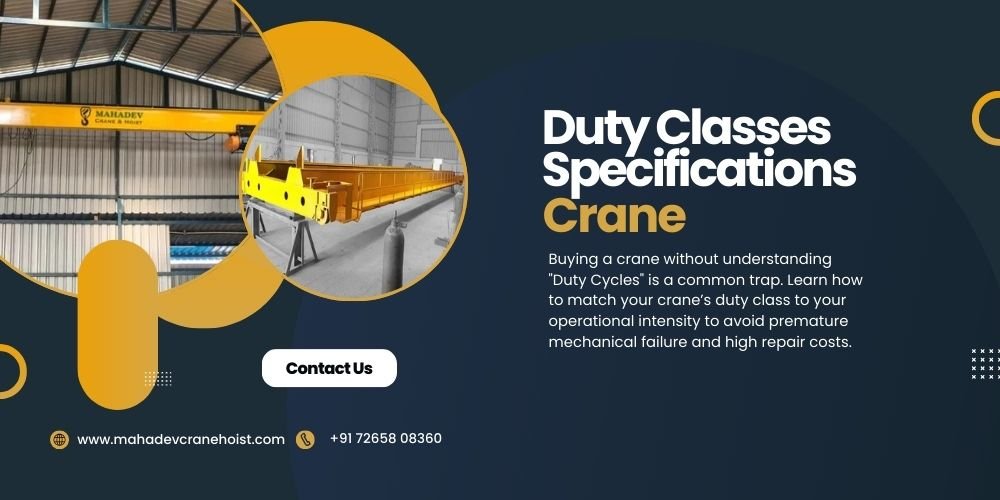
At Mahadev Crane Hoist, we often see factory managers purchase a high-quality crane, only to have the hoist motor fail within a year. The problem isn’t the quality of the crane—it’s that the Duty Cycle was never matched to the actual workload.
In the world of industrial material handling, a crane is not just a lifting tool; it is a mechanical system with a finite “lifespan” based on hours of operation. Understanding Duty Cycles is the secret to getting 15–20 years out of your equipment instead of just two.
What is a Crane Duty Cycle?
A Duty Cycle (often categorized by ISO or FEM standards, such as M3, M5, or M7) is a measure of how hard and how often a crane is used. It considers:
- The frequency of lifts per hour.
- The average weight of the loads.
- The total distance the crane travels.
The Categories: Are You Light, Medium, or Heavy?
- Light Duty (M3/Class B): Used for maintenance shops or periodic assembly. The crane is rarely used at full capacity and operates only a few hours per week.
- Medium Duty (M5/Class C): Common for general manufacturing and machine shops. These cranes see daily use but with frequent rest periods between lifts.
- Heavy Duty (M7/Class D): Used in steel mills, foundries, and granite processing plants. These cranes operate continuously, often with loads near the maximum capacity, requiring robust motors, high-grade brakes, and reinforced steel girders.
The Cost of "Mismatching"
If you install a Light Duty Crane in a Heavy Duty environment (like a high-output stone cutting facility), here is what happens:
- Thermal Overload: The motor will constantly overheat, leading to burned-out windings.
- Gearbox Fatigue: Gears designed for occasional use will strip their teeth under continuous high-torque stress.
- Structural Stress: The bridge girders may experience structural fatigue, leading to cracks in the weld joints.
How Mahadev Crane Hoist Ensures Longevity
When you partner with us, we perform a Workload Audit before recommending a crane. We ask:
- “How many shifts per day?”
- “What is the weight of your heaviest load?”
- “What is your cycle time per lift?”
By analyzing these variables, we select the correct motor horsepower, gearbox ratio, and Wire Rope Hoist specifications to ensure your crane is “over-engineered” for safety, not under-engineered for your workload.