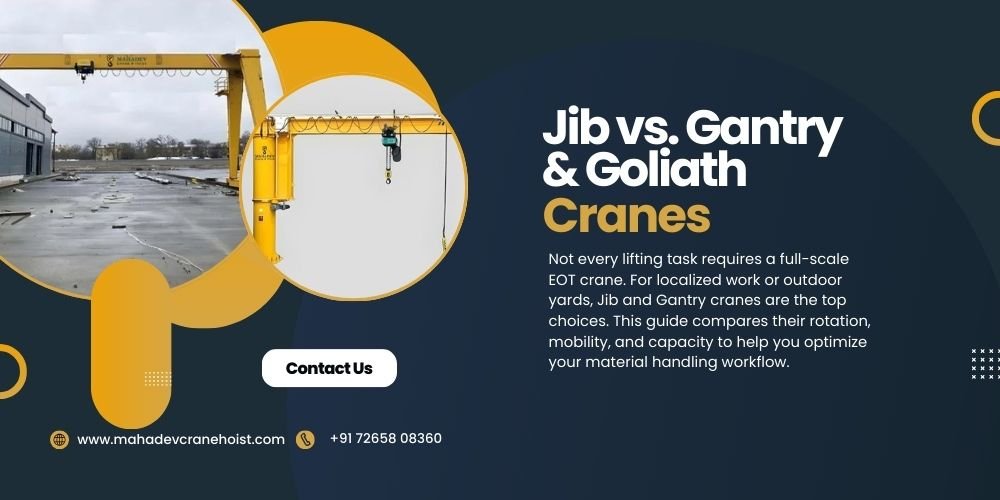
When planning a facility layout, one size rarely fits all. While EOT Cranes cover the entire length of a factory, many operations require specialized lifting in specific zones. This is where Jib Cranes and Gantry & Goliath Cranes come into play. Choosing between them depends on your available floor space, whether the work is indoor or outdoor, and how much weight you need to move. Let’s break down which of these “Titan” lifting solutions belongs in your facility.
1. Jib Cranes: The Workstation Specialist
A Jib Crane consists of a horizontal boom (jib) attached to a vertical mast or a building column. It is designed for repetitive tasks within a fixed radius.
-
Best For: Assembly lines, machining centers, and maintenance bays.
-
Space Profile: Extremely compact. Wall-mounted versions require zero floor space, while Pillar Jib Cranes only need a small foundation.
-
Movement: Offers 180° to 360° rotation. It is the king of “point-to-point” movement within a circular area.
-
Capacity: Typically ranges from 250 kg to 5 tons.
When to choose a Jib Crane? If your workers need to lift parts onto a CNC machine or assemble heavy components at a single station, a Jib Crane is the most ergonomic and cost-effective choice.
2. Gantry & Goliath Cranes: The Heavyweight All-Rounder
Gantry Cranes (often called Goliath Cranes when designed for massive capacities) are bridge cranes supported by independent legs that move on floor-level rails or wheels.
-
Best For: Outdoor steel yards, shipping docks, pre-cast concrete plants, and heavy fabrication shops where overhead runways aren’t feasible.
-
Space Profile: Requires a clear path on the ground for the rails or wheels. However, it doesn’t put any “stress” on the building structure.
-
Movement: Moves in a straight line along a track. It covers a rectangular area, making it ideal for moving materials from one end of a yard to the other.
-
Capacity: Can handle anywhere from 5 tons to over 100 tons in Double Girder Goliath configurations.
When to choose a Gantry/Goliath Crane? If you are working in an open yard or a rented facility where you cannot install overhead runway beams, a Gantry Crane provides full-scale lifting power without structural modifications.
Key Differences at a Glance
| Feature | Jib Crane | Gantry / Goliath Crane |
| Mounting | Wall or Pillar Mounted | Floor Rail or Wheel Mounted |
| Rotation | 180° to 360° | Linear (Back and Forth) |
| Indoor/Outdoor | Primarily Indoor | Excellent for Outdoor |
| Typical Loads | Light to Medium | Medium to Ultra-Heavy |
| Installation | Quick and Simple | Requires Rail/Floor Prep |
Semantic Spotlight: Semi-Gantry Cranes
For facilities that want the best of both worlds, a Semi-Gantry Crane is a popular hybrid. One side runs on an overhead runway (like an EOT crane), while the other side runs on floor rails. This is perfect for high-traffic areas where you need to keep one side of the floor clear for forklifts.
Expert Guidance from Mahadev Crane Hoist
At Mahadev Crane Hoist, we manufacture high-tensile Jib Cranes for precision workstations and robust Gantry & Goliath Cranes for the most demanding environments. Our designs prioritize safety, using high-quality Wire Rope Hoists and precision-engineered end carriages to ensure smooth travel even under maximum load.
Is your current hoist showing signs of wear?
Contact Mahadev Crane Hoist for a technical consultation or a quote on a high-durability Wire Rope Hoist replacement today!