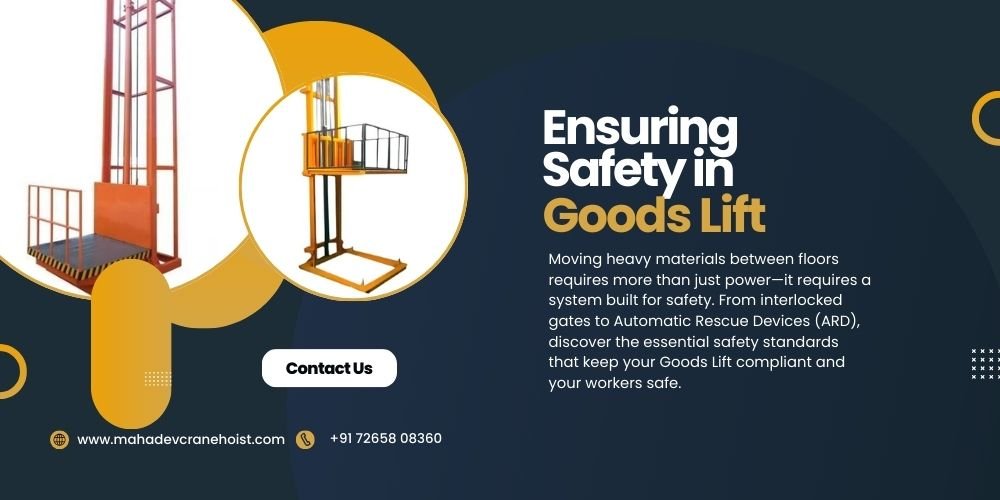
In a multi-level manufacturing facility or warehouse, the Goods Lift (also known as a Freight Elevator) is the backbone of vertical logistics. While EOT Cranes handle horizontal movement, Goods Lifts are the “muscle” that ensures raw materials and finished products reach the correct floor quickly and safely. However, because these lifts transport thousands of kilograms vertically, safety cannot be an afterthought. In India, industrial lifts must adhere to strict guidelines to prevent accidents and ensure long-term operational reliability.
Critical Safety Features Every Goods Lift Needs
At Mahadev Crane Hoist, we believe a Goods Lift is only as good as its safety systems. Here are the “non-negotiable” features that every industrial lift should have:
1. Mechanical & Electronic Interlocked Gates The lift should never move unless all gates are fully closed and locked. Similarly, the gates should not be openable unless the lift car is precisely at that floor level. This prevents the most common cause of lift-related accidents.
2. Automatic Rescue Device (ARD) In the event of a power failure, an ARD is a battery-operated system that automatically moves the lift to the nearest floor and opens the doors. This is essential for preventing goods from being stuck between floors during a production shift.
3. Overload Sensors and Alarms Industrial environments often involve varying load weights. Overload sensors prevent the lift from starting if the weight exceeds its rated capacity, protecting the motor and the wire ropes from excessive strain.
4. Emergency Stop and Buffers Emergency stop buttons must be available both inside the car and at every landing. Additionally, heavy-duty buffers at the bottom of the lift pit act as shock absorbers in the highly unlikely event of a mechanical failure.
Understanding Indian Standards (IS 14665)
To build a truly authoritative factory, your equipment must meet national standards. In India, the IS 14665 series (published by the Bureau of Indian Standards) governs the design, installation, and maintenance of electric traction lifts.
-
Design Precision: Standards dictate the minimum thickness of the car walls, the strength of the guide rails, and the safety factor of the hoisting ropes.
-
Testing Protocols: Before a Goods Lift is commissioned, it must undergo “load testing” where it is operated at full capacity to ensure all brakes and safety gears work under pressure.
-
State Regulations: Remember that in many Indian states, including Gujarat, you are required to obtain a “License to Operate” from the Electrical Inspectorate after a physical inspection.
Maintenance: The Key to Reliability
A Goods Lift in a busy factory might run 50 to 100 times a day. To avoid expensive breakdowns, follow a “Preventative Maintenance” schedule:
-
Monthly: Lubricate guide rails and check wire rope tension.
-
Quarterly: Test the ARD battery and inspect the brake lining.
-
Annually: Conduct a full safety audit and renew your government license.
Why Mahadev Crane Hoist for Your Vertical Logistics?
We don’t just manufacture lifts; we engineer safety. Our Goods Lifts are custom-built for industrial durability, featuring non-slip flooring, robust steel cages, and high-performance Wire Rope Hoists or hydraulic systems. Whether you are moving 500 kg of textiles or 5,000 kg of heavy machinery, our lifts are designed to perform under the toughest conditions.
Planning a new facility or looking to upgrade your current vertical transport?
Contact Mahadev Crane Hoist today for a Goods Lift solution that meets all Indian safety standards and boosts your factory’s efficiency!