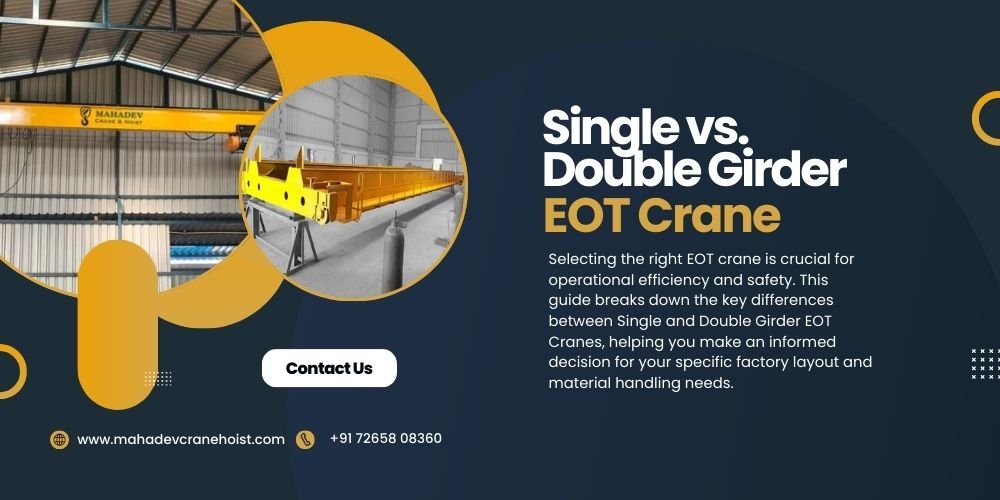
In the world of heavy-duty material handling, Electric Overhead Traveling (EOT) cranes are indispensable. They lift, move, and position heavy loads with precision, transforming productivity in factories, warehouses, and workshops. However, when it comes to selecting the right EOT crane, one of the most fundamental decisions you’ll face is between a Single Girder EOT Crane and a Double Girder EOT Crane.
Both serve the primary purpose of overhead material movement, but their design, capabilities, and ideal applications differ significantly. Understanding these differences is key to optimizing your factory layout, ensuring operational efficiency, and making a cost-effective investment.
Understanding the Basics: What Defines Each Type?
1. Single Girder EOT Crane
As the name suggests, a Single Girder EOT Crane features one main bridge girder. The hoist and trolley assembly run along the bottom flange of this single girder.Key Characteristics:
- Design: Simpler and more compact.
- Weight: Lighter in structure.
- Headroom: Requires less headroom due to the hoist running beneath the girder.
- Span: Typically used for shorter to medium spans. Capacity: Generally suited for lighter to medium load capacities.
2. Double Girder EOT Crane
A Double Girder EOT Crane, in contrast, utilizes two main bridge girders. The hoist and trolley assembly typically run on rails positioned on top of these two girders.Key Characteristics:
- Design: More robust and complex.
- Weight: Heavier and more substantial structure.
- Headroom: Offers superior lifting height, as the hoist sits between or on top of the girders, maximizing space.
- Span: Ideal for longer spans. Capacity: Designed for heavier load capacities and higher duty cycles.
Head-to-Head Comparison: Single vs. Double Girder EOT Crane
Let’s delve deeper into the critical factors that will influence your decision:
1. Load Capacity & Span
-
Single Girder: Best for loads up to approximately 20 tons and spans up to around 25-30 meters. Perfect for general workshop use, light manufacturing, and maintenance tasks.
-
Double Girder: Engineered for much heavier loads, often exceeding 100 tons, and capable of spanning over 30 meters. This makes them indispensable for heavy fabrication, steel mills, shipyards, power plants, and large industrial facilities.
2. Headroom & Lift Height
-
Single Girder: The hoist runs below the girder, which means it requires less vertical space from the ceiling to the hook. If your facility has limited overhead clearance, a single girder might be your only option.
-
Double Girder: Since the hoist sits on top of or between the two girders, it provides a significantly higher hook lift. For applications where maximizing vertical storage or stacking is crucial, double girder cranes are superior.
3. Cost (Initial Investment & Maintenance)
-
Single Girder: Generally more cost-effective in terms of initial purchase and installation. Their simpler design also often translates to lower maintenance costs over time due to fewer components and easier access.
-
Double Girder: Involves a higher initial investment due to their more complex structure, greater material usage, and often more powerful hoisting mechanisms. However, for the right application, their enhanced capabilities deliver a higher return on investment.
4. Design & Structure
-
Single Girder: Lighter bridge weight, putting less stress on runway structures and building columns. This can potentially save on civil construction costs.
-
Double Girder: Heavier bridge weight requires a more robust runway structure and stronger building supports, which should be factored into overall project planning.
5. Operational Control & Speed
-
Both types can be equipped with advanced control systems, including variable frequency drives (VFDs) for precise speed control. However, double girder cranes, especially those handling very heavy loads, are often designed for smoother, more stable movement, reducing sway and improving operator confidence.
Which EOT Crane is Right for Your Factory Layout?
To make an informed decision, consider these questions:
-
What is the maximum weight you need to lift? (This is the primary factor.)
-
What is the required lifting height (from the floor to the hook)?
-
What is your available headroom (from the floor to the ceiling/roof truss)?
-
What is the span of your facility where the crane will operate?
-
How frequently will the crane be used, and for what duty cycle (FEM/ISO standards)?
-
What is your budget for initial purchase, installation, and long-term maintenance?
-
Do you have any specific operational requirements, such as handling delicate materials or needing extremely fine positioning?
Mahadev Crane Hoist: Your Partner in Crane Selection
Choosing between a Single Girder EOT Crane and a Double Girder EOT Crane is a significant investment that impacts your entire operation. At Mahadev Crane Hoist, we understand the nuances of various industrial environments. Our team of experts can conduct a thorough assessment of your factory layout, material handling needs, and operational goals to recommend the most efficient, safe, and cost-effective EOT Crane solution.
Whether you need a compact single girder for your workshop or a robust double girder for heavy industrial applications, we are committed to providing tailor-made solutions built for durability and performance.
Not sure which EOT Crane suits your facility best?
Contact Mahadev Crane Hoist today for a free consultation and site assessment!